


ASTM A6 STEEL PLATE FLATNESS – What Can You Expect?
Flatness matters when plate is going directly into fabrication, machining, welding, forming or precision assembly. Clifton Steel targets one-half of the applicable ASTM A6 standard flatness tolerance whenever the product and grade permit.
ASTM A6 is the baseline. Clifton goes flatter.
ASTM A6 establishes general dimensional requirements for rolled structural steel products, including plate. Its flatness requirements vary with plate thickness, specified width, plate type and strength level. Clifton Steel’s objective is to supply plate substantially flatter than the standard commercial allowance.
Our target: 50% of the applicable ASTM A6 flatness allowance.
This means a plate permitted to have, for example, 1/2 inch of variation under the applicable A6 requirement would have a Clifton target of approximately 1/4 inch. Actual achievable flatness depends on grade, thickness, width, heat treatment, dimensions and processing condition.
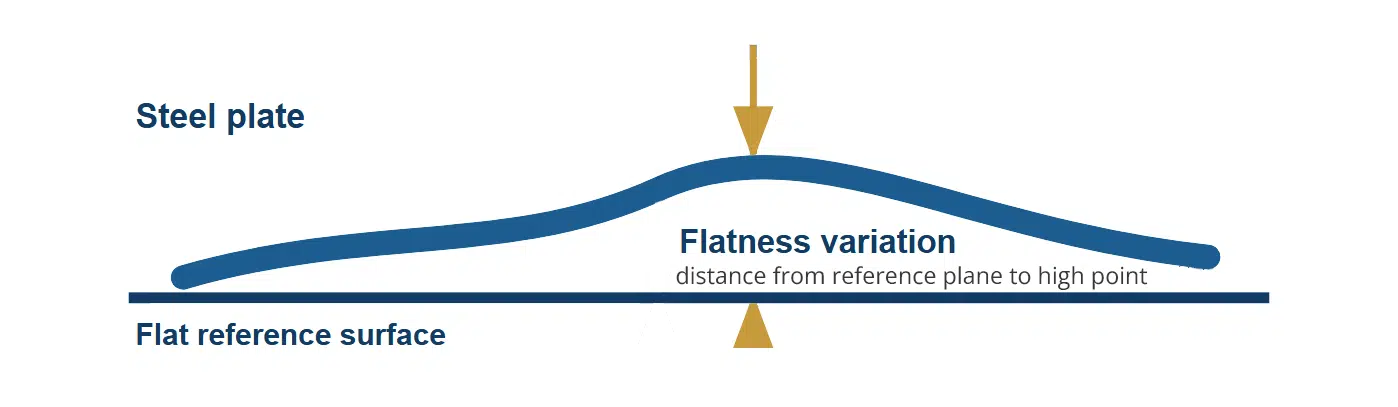
Flatness
The overall deviation of the plate from a flat reference surface when the plate is resting horizontally on a flat surface.
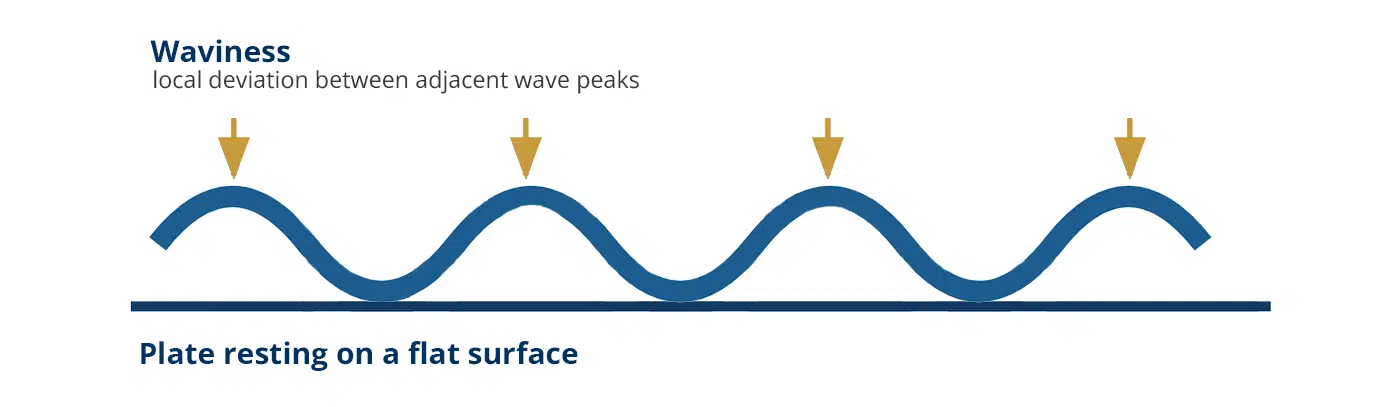
Waviness
Shorter, repeated waves or undulations in the plate surface. ASTM A6 treats waviness separately than standard-flatness plates.
Measurement
ASTM measurement is made with the plate positioned horizontally on a flat surface. Length and width have separate considerations.
How ASTM A6 Flatness Is Measured
Think of the plate as resting on a perfectly flat reference surface. The maximum permitted deviation is the distance from that reference plane to the highest point of the plate surface, measured according to the applicable ASTM provisions.
Representative ASTM A6 Flatness Limits — Carbon Steel Plate
For standard-flatness thermally treated steel plate, ASTM A6 establishes permitted variation according to specified thickness and width. The table below is a representative reference from ASTM A6 Table 14. Clifton’s one-half target is shown beside the ASTM value. For a purchase order, the exact applicable specification, grade, and edition should be confirmed.
| Thickness | Width ≤36" | Clifton 1/2 | Width 36-48" | Clifton 1/2 | Width 48-60" | Clifton 1/2 | Width 60-72" | Clifton 1/2 |
|---|---|---|---|---|---|---|---|---|
| To 1/4" | 13/16" | 13/32" | 1 1/8" | 9/16" | 1 3/8" | 11/16" | 1 7/8" | 15/16" |
| 1/4" - 3/8" | 3/4" | 3/8" | 15/16" | 15/32" | 1 1/8" | 9/16" | 1 3/8" | 11/16" |
| 3/8" - 1/2" | 3/4" | 3/8" | 7/8" | 7/16" | 15/16" | 15/32" | 1 1/8" | 9/16" |
| 1/2" - 3/4" | 5/8" | 5/16" | 3/4" | 3/8" | 13/16" | 13/32" | 7/8" | 7/16" |
| 3/4" - 1" | 5/8" | 5/16" | 3/4" | 3/8" | 7/8" | 7/16" | 7/8" | 7/16" |
| 1" - 2" | 9/16" | 9/32" | 5/8" | 5/16" | 3/4" | 3/8" | 13/16" | 13/32" |
| 2" -4" | 1/2" | 1/4" | 9/16" | 9/32" | 11/16" | 11/32" | 3/4" | 3/8" |
| 4" - 6" | 9/16" | 9/32" | 11/16" | 11/32" | 3/4" | 3/8" | 7/8" | 7/16" |
Important: This is a customer-facing quick-reference table, not a substitute for the controlling ASTM specification or purchase-order requirements. ASTM A6 contains additional thickness/width ranges and separate provisions for high-strength/alloy products.
What About Plate Length?
ASTM A6 evaluates flatness along the longer dimension as the specified length. For plates up to 12 ft long, the permitted variation is evaluated over the plate length; for longer plates, the applicable flatness allowance is evaluated in any 12-ft portion. Across the width, the variation may not exceed the applicable tabular amount.
Short plates have additional limits
ASTM A6 includes special provisions when the longer plate dimension is under 36 inches and when it is between 36 and 72 inches. These provisions can control the result rather than simply applying a straight 50% mathematical reduction to a table value.
Why Flatness Matters to Your Project
Laser & Waterjet Cutting
Flatter plate can improve workholding, reduce rocking, and make downstream processing more predictable.
Machining
Better incoming flatness can reduce the amount of stock removed just to establish a reliable machining plane.
Welding & Fabrication
Flatter material can help reduce fit-up problems, distortion-related adjustments, and unnecessary straightening work.
Forming
More consistent starting geometry can make forming and fixture setup more repeatable.
Assembly
Flat components are easier to fixture, align, and position when flatness is part of the finished product requirement.
Critical Applications
When flatness affects your process, discuss the requirement with Clifton before ordering so the appropriate grade, condition, and tolerance can be specified.
ASTM A6 vs. Clifton Steel's 1/2-A6 Target
| Requirement | ASTM A6 Standard | Clifton Steel Target |
|---|---|---|
| Overall flatness | Applicable A6 table value | Approximately 50% of applicable A6 value |
| Measurement basis | Plate horizontal on flat surface | Plate horizontal on flat surface |
| Width effect | Allowance changes with specified width | Target follows applicable A6 requirement |
| Thickness effect | Allowance changes with thickness | Target follows applicable A6 requirement |
| High-strength / alloy grades | Separate A6 provisions may apply | Confirm grade-specific requirement with Clifton |
| Waviness | Separate Table 15 provisions for standard-flatness plates | Confirm required waviness/flatness condition with Clifton |
Need flatter plate for a critical application?
Tell Clifton Steel your grade, thickness, width, length, and process requirement. We can help determine the appropriate flatness target before the plate reaches your shop. Talk to Clifton SteelTechnical note: ASTM A6/A6M is a copyrighted standard. This page summarizes its flatness concepts for customer education and does not reproduce the complete standard. In the event of a conflict, the applicable ASTM product specification and the purchase order control.